A month that still closes
Fractional CFO Near Me for a closing month
Near me usually means someone who will show up. Here it means someone who shows up every month. The books kept, payroll set up, the return prepared, and a person on the screen who read the month and will tell you what it means. Steven Palmieri, the Tax CFO, does that work with you while the months are still open enough to change.
What a fractional CFO near you should actually do.
Mileage is not what finishes the month. We close it on a named day, keep payroll set up on your provider, prepare the return from the closed months, and read October with you while the year can still move. That is the Tax CFO. Near is the screen you are already looking at.
What showing up means here
Showing up, on this practice, is a named day. The books close that day. Payroll stays set up with the provider you already chose, and the pay run stays with them. We do not open the return while a bank balance is still floating. October is read with you while the year can still move. The person who only totals the closed month has finished that total and stopped. The Tax CFO part is the choice that total still leaves open, the wage, the truck, or the set-aside, while the year can still change. Near, on this site, means close enough to make that choice with you.
Name the town and the bank
Name and phone are enough.
 You will be talking to the Steven Palmieri practice.
 Click to read questions ›Tap to read questions ›
Who picks up each month
Monday after a big weekend, someone asks whether the deposits landed. That someone is us.
 Click to see the drive ›Tap to see the drive ›
A visit never closed the month
A visit can feel pleasant and still leave the month open.
 Click to see the close ›Tap to see the close ›
After the last day of the month
The bank feeds arrive without anyone carrying them, and the statements still have to agree with each other.
 Click to check sales tax ›Tap to check sales tax ›
The rate that belongs to your town
Say the town and we read its sales-tax rate against your receipts. The zip code does not hold the license. The month holds the work.
 Click to see zip limits ›Tap to see zip limits ›
A zip code holds no license
A distance sort orders buildings. It never held a license.
 Click to see the example ›Tap to see the example ›
A town nobody drove to
A busy September will not match a quiet August.
Six months, one line
Six months where a filing or a choice still shows up.
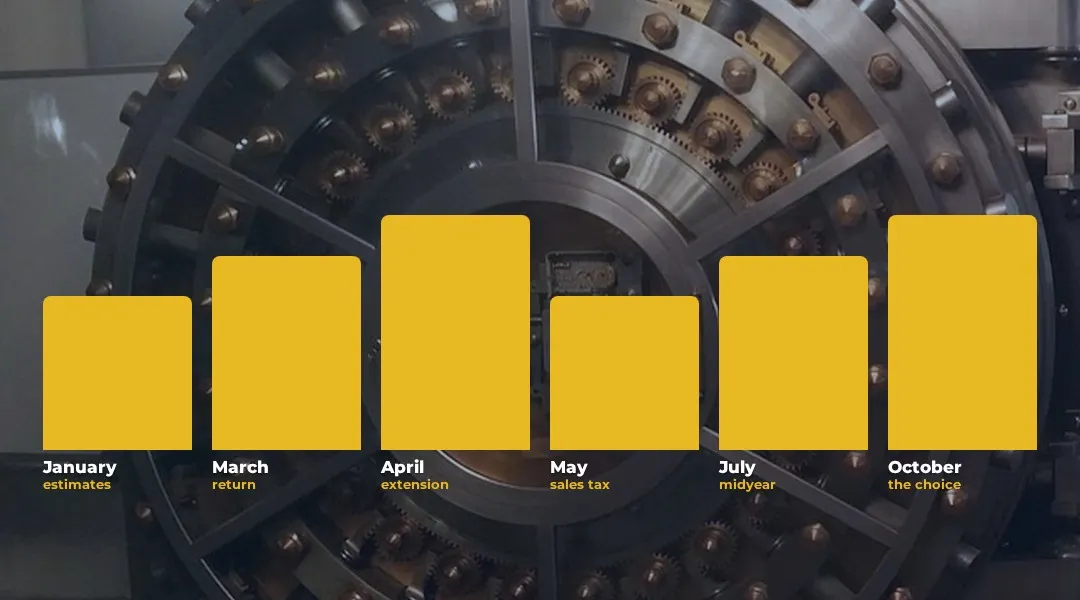
The months still on our line
Open a month and see the filing we handle with you, and the choice that is still yours.
1January
The first estimate of the year is built from the tax you actually owed, and it goes out only after you have seen the number.
We prepare the voucher. Nothing goes out until you have approved the amount.
2March
The return is prepared from books that already match the bank, so signing confirms a number you have already lived with.
We prepare the return. You sign it when it matches what you expected.
3April
April is when a first quarter estimate or an extension still has to be decided from the year already closed, rather than a fresh scramble.
We prepare that report from the year we already closed with you.
4May
Spring sales tax is checked against where you really sell, not against the rate the software guessed on the day it was set up.
We tie the sales tax return to the books before it is filed.
5July
The midyear estimate is rebuilt from the months that have already closed, so a strong spring is not a surprise in April.
We rerun the projection. You decide what to send.
6October
A wage, a truck, or a retirement contribution can still change the year in October, and that choice sits on one page while there is time.
We bring the closed months. You make the call.
Steven Palmieri, Tax CFO
Finished months still get a conversation while they are fresh.
Tell us the town, the bank, and the last month that actually closed.
Bring the month that will not close
You will be talking to the Steven Palmieri practice.
More of the story
What near me usually means
People say near me because they want two ordinary things. They want someone who will name the town, the sales tax, and the lender without inventing a lobby on their street. And they want someone who will still pick up in July.
Neither of those is a mileage question. The first is a file that has the local stack written down, with the source beside it. The second is a practice that is run so the same person answers. A building down the road can fail both, and a practice a long drive away can pass both.
We do not keep an office in your town, and we will not pretend a pin on a map is the work. If you learned that a close does not need a driveway, you can stop there. The rest of the site is for the owner who wants the month finished anyway.
The zip code does not hold the permission. The month holds the work. A distance sort does not say who may sign a reserved report, and it never did. The close itself happens on a video call, on the same day of the month, from the screen you already open.
What the first month feels like
The bank and the cards connect so the transactions stop needing a bag. We send one list of the things a feed cannot know, which deposit was borrowed, which charge was personal, which invoice was paid in two pieces. You answer that list once.
Then every account is agreed to a statement. Cash, the cards, the loans. Nothing is called finished while a balance is still floating. After that we read the month with you while it is still fresh enough to matter.
What the first month costs follows the backlog, the number of accounts, and whether sales tax or a payroll setup belongs in that first pass. The quote comes before you commit. Printing a typical price would describe a company that is not yours, so this page refuses to.
That someone is us, and the question is on the calendar before the week gets away from the drawer. A close is a list of unknowns you answer in one sitting, and it works better written down than it does from a driveway. Cash, the cards, and the loans each have to agree to a statement before anyone uses the word finished.
The past, the present, and October
The past is the months that never got tied, and the rate that was typed in once and never looked at again. We work that oldest first, with an end date on the backlog, so catch up is a project and not a mood.
The present is a fixed day each month when the close is done and you hear what it means. Account labels stay where we put them, which is what lets one year sit beside another. The person who already runs payday stays the one who runs it. We only arrange the payroll file so that person can start, and we leave the pay run on their side.
October is the month when a wage for an owner, a piece of equipment, or a retirement contribution can still change the year. We put that choice in front of you while there is time. By the time you sign the return, you have already lived with the number.
A made up week, so the shape is visible
Picture a week that is not anyone's actual books. Customer money comes in. Rent goes out. A sales tax set aside sits in its own place so it is not spent as if it were profit. The owner's draw stays in its own account, not mixed into wages.
Stretch the sketch over thirteen weeks and the draw, the rent, and the tax set aside stop sharing a pile. That sheet is for running the shop. It is not a filing and nobody signs it as a prediction. You decide the rows. After the month ties, and again when one large invoice rearranges the cash, we rebuild the sheet.
Nothing in that sketch is a client result. It is the shape of a conversation, so you can see what we would open with you.
While the lights of a long weekend are still in your head, we watch a second thing, the sales tax for that month, because a busy September will not match a quiet August.
If a signed report is the real need
Some owners arrive wanting the month closed and discover, in the conversation, that a lender wants a report on the statements. We say that plainly. Preparation of the statements can stay here. The report that offers assurance does not.
The disclosures page holds the full line, including what this practice keeps without that credential and what it reserves. Read it before you book if you want the limit in one place. If the limit is the only thing you needed, you have it, and you do not owe us a call.
Finished months get a conversation while they are still fresh, under the Tax CFO title and the Entrepreneur's CFO title together. When a lender truly needs a signed report on the statements, that need is named and pointed outward.